
When you think of automobile manufacturing, images of massive stamping presses, flying sparks, and busy robots may come to mind. But behind the scenes, a seemingly “low-key” technology is quietly becoming mainstream—laser welding.
If traditional welding is like “needle and thread,” then laser welding is the “light-speed tailor” of the automotive manufacturing industry. With a beam of invisible light, it is redefining how car bodies, chassis, and battery packs are joined together.
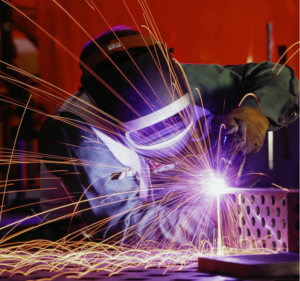
Why Are Auto Giants Flocking to Laser Welding?
Compared to traditional resistance spot welding or arc welding, the advantages of laser welding are truly game-changing:
- Lightning-Fast Speed: Laser welding speeds can reach several to over ten meters per minute—several to dozens of times faster than traditional welding methods. This translates to faster production cycles and higher output.
- Minimal heat-affected zone: Laser energy is highly concentrated, resulting in narrow welds and low heat input, which minimizes workpiece deformation. This makes it particularly suitable for “delicate” materials such as high-strength steel and aluminum alloys.
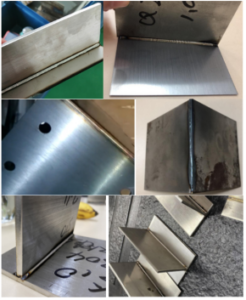
- High-strength, aesthetically pleasing welds: With a high depth-to-width ratio, superior metallurgical quality, and smooth surface finish, laser welds are ideal for automotive body panels, which can proceed directly to painting without the need for grinding.
- Greater design flexibility: Laser welding enables remote welding and 3D curved welding, freeing engineers from the constraints of torch accessibility and allowing them to design lighter, stiffer structural topologies.
Where exactly is it welded in automotive parts?
The car you drive every day is likely covered in laser “stitches”:
- 1. Body frame—white body
Doors, side panels, roof, pillars… Laser-welded blanks (TWB) are a classic application. Steel sheets of varying thicknesses and strengths are pre-welded into a single blank using laser technology, which is then stamped as a whole. This ensures strength in the crash zones while reducing weight in non-load-bearing areas. Laser brazing between the roof and side panels creates smooth, continuous, and aesthetically pleasing welds, completely eliminating unsightly rubber seals. - 2. Powertrain and Chassis Components — Gears, Transmissions
For precision parts in transmissions, such as gears and synchronizer rings, laser welding enables distortion-free joining, ensuring transmission accuracy. Differential housings, which were traditionally bolted together, are now frequently laser-welded, reducing weight while improving rigidity and sealing performance. - 3. Exhaust Pipes and Chassis Structural Components
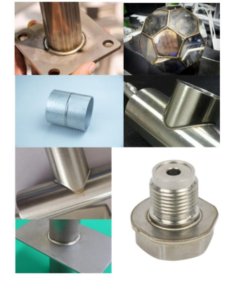
For circumferential seam welding of stainless steel exhaust pipes, laser welding delivers high-speed, clean connections with a minimal heat-affected zone and superior corrosion resistance. Certain chassis components, such as suspension control arms and subframes, are also increasingly adopting laser welding to meet the dual demands of lightweight design and high strength. - 4. The Core of New Energy Vehicles—Power Batteries
This is the hottest application area for laser welding in recent years. From the tabs, busbars, and pressure relief valves within battery modules to the battery pack casing and cooling plates… virtually all internal electrical and sealing connections rely on laser welding. This is because battery materials are extremely sensitive to heat—overheating can damage the separator and trigger thermal runaway. The precision control capabilities of laser welding are irreplaceable.
The Road Ahead: More Aluminum, More Challenges
As all-aluminum bodies, steel-aluminum hybrid bodies, and solid-state batteries become more widespread, laser welding still faces challenges such as aluminum’s high reflectivity, porosity control, and copper spatter. But there is no doubt that on the path toward “lighter, stronger, and smarter” automobiles, the light of laser welding will shine ever brighter.
The next time you see a car with sleek lines and uniform seams, take a moment to consider: that might just be a masterpiece created by a laser in a thousandth of a second.