In the field of metal surface treatment, the choice of cleaning method directly affects product quality, production costs, and environmental compliance.
Traditional acid pickling versus emerging laser cleaning: which is superior? Now provides a comprehensive analysis for your reference.
I. Pickling: Mature but Costly
Pickling is a process that uses acid solutions (sulfuric acid, hydrochloric acid, phosphoric acid, etc.) to chemically react with oxides and rust on metal surfaces, dissolving and removing them.
✅ Advantages of Pickling:
- Large Processing Area: Enables rapid cleaning of large batches and large areas of material.
- Mature Technology: Widely used in industries such as steel and machinery, with a well-established process system.
- Good Surface Quality: Removes iron oxide scale, facilitating subsequent welding, oiling, and painting.
❌ Pain Points of Pickling:
- Complex Process: Chemical degreasing → hot water washing → running water washing → pickling → running water washing → secondary pickling… up to a dozen steps.
- Severe Pollution: Generates large amounts of acid-containing waste liquid, hydrogen chloride mist, waste residue, and other pollutants.
- Low Operational Error Tolerance: Highly prone to defects such as oxygen spots, yellow spots, under-pickling, and over-pickling, resulting in a high scrap rate.
- Residual Acid Hazard: Residual acid in the gaps of complex structural parts is difficult to completely remove, easily causing subsequent corrosion.
- High Cost: Excluding equipment costs, the monthly operating cost of a pickling workshop starts at 17000-25000 USD.(a reference cost)
II. Laser Cleaning: A Green and Efficient Innovator
Laser cleaning utilizes a high-energy laser beam to irradiate a surface, causing contaminants to rapidly vaporize or peel off.
✅ Advantages of Laser Cleaning:
- Simple Process: No pretreatment required; simply turn on the equipment to begin cleaning – one-step process.
- Environmentally Friendly: No chemical agents or cleaning solutions used; no wastewater or waste liquid discharge; waste is a solid powder for easy collection.
- Non-Damaging to Substrate: Non-contact cleaning with a minimal heat-affected zone (typically <10μm), preventing damage to the substrate.
- High Precision: Precise control over the cleaning area, suitable for complex shapes and high-precision requirements.
- High Efficiency: Cleaning speeds can reach 0.5-5 m²/min, 3-5 times faster than traditional acid washing.
- High Cleanliness Level: Up to Sa3, the highest industrial cleaning level.
- Low Long-Term Cost: Almost no consumables besides initial equipment investment; unit cost decreases with scale.
- Easy to Automate: Can be integrated with robots for automated operation.
❌ Limitations of Laser Cleaning:
- High initial investment: Equipment purchase costs may higher than traditional acid washing equipment.
- Technology is still under development: Applications in some special working conditions are still being explored.
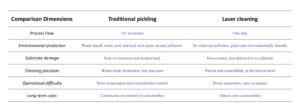
III. Comprehensive Comparison Overview