
As we all know, laser marking, unlike printing, doesn’t use ink as a consumable. However, in some cases, its marking effect on metals, such as color, can be adjusted. Why is this?
Fiber lasers can mark colors on metals, and their core principle is “laser-induced thin-film interference.” The color changes follow a predictable pattern, primarily determined by the thickness of the oxide film formed on the metal surface.
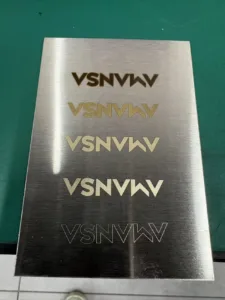
🧬 The Source of Color: The “Thin-Film Interference” Game of Light
This phenomenon can be explained by “thin-film interference,” the specific process of which is as follows:
Laser Heating and Oxidation: High-energy fiber lasers (commonly with a wavelength of 1064nm) irradiate the surface of metals such as stainless steel and titanium alloys. The heat from the laser causes an extremely thin layer on the metal surface to rapidly heat up in the air and oxidize, forming a transparent oxide film. This film is typically tens to hundreds of nanometers thick and is invisible to the human eye.
Light Interference: When white light (such as sunlight) shines on this metal surface with the oxide film, a remarkable optical phenomenon occurs:
Part of the light is directly reflected from the upper surface of the oxide film (ray 1).
The other part of the light passes through the transparent oxide film, reaches the interface between the oxide film and the metal, and is reflected back (ray 2).
Color Manifestation: These two reflected beams (ray 1 and ray 2) meet in the air. Due to the different path lengths they have traveled, they overlap like water waves.
When the crests of two beams of light meet, the light of that color is amplified, appearing exceptionally bright.
When the crests meet the troughs, the light of that color is canceled out.
Since white light is composed of multiple colors, different wavelengths of light are selectively amplified or attenuated, and what we ultimately see is the specific color produced by the mixture.
🎨 The Laws of Color: A Thickness-Driven “Spectrum” Variation
Color appearance follows a very clear pattern, with the core variable being the thickness of the transparent oxide film.
Thickness Determines Color: Even minute changes in oxide film thickness directly alter the optical path difference between two reflected light beams, thus changing the wavelength (i.e., color) of the strengthened or weakened light.
The Sequence of Color Change: Theoretically, as the oxide film thickness gradually increases, the observed colors cycle according to a specific spectral order: violet → blue → cyan → green → yellow → orange → red. This means that by precisely controlling the oxide film thickness, the desired color can be “tuned.”
Equivalence of Parameter Combinations: Research shows that parameters such as laser power, scanning speed, and pulse frequency, as long as their combined thermal effect is the same, even if individual values differ, can produce oxide films of the same or similar thickness, resulting in identical colors.
⚙️ The Determining Factors: More Than Just the Metal Itself
The final color is the result of a combination of factors, far beyond just the type of metal.
**Material Properties of the Metal:** This is the material basis of color. Different metals (such as stainless steel and titanium alloys) produce different types of oxides and optical properties after oxidation. For example, stainless steel mainly produces iron oxides and nitrides after oxidation, while titanium alloys produce titanium oxides and nitrides. These different substances inherently possess different colors and refractive indices.
**Laser Process Parameters:** This is the core tool for controlling color. The operator precisely adjusts the following parameters to control the energy input to the metal surface, thereby “carving” oxide films of different thicknesses:
**Laser Power**
**Scanning Speed**
**Pulse Frequency**
**Pulse Width**
**Fill Spacing**
**Environmental and Observational Factors:** This is an important external variable. The oxidation process occurs in the air, and the participation of oxygen is indispensable. Furthermore, due to interference phenomena, the viewing angle also affects the color we see. The same colored mark may show subtle color changes when viewed from different angles.
Therefore, sometimes the parameters we adjust according to the customer’s requirements before shipping may not produce the same marking effect when the customer operates the machine themselves.
Materials and even the environment can affect the final result.