
In an increasingly competitive market, how can you ensure your products showcase quality in the details? How can you give precision components permanent, clear markings? Are traditional marking methods troubling you—for example, concerns about product damage, unclear markings, or low efficiency?
Today, we recommend a cutting-edge device that solves these pain points—the UV laser marking machine. It’s not just a tool, but a powerful partner for enhancing product added value and protecting your brand reputation.
What is it? Simply put, it’s a “cold light engraver.”
Unlike common “thermal processing” lasers (such as fiber lasers), UV lasers, with their extremely short wavelength and extremely high energy peak, are a “cold processing” process.
Thermal processing: Like cutting with a flame, it melts and burns materials, creating a heat-affected zone, which may cause product deformation, yellowing, or internal damage.
Cold processing: Like peeling with an extremely fine “light knife,” it directly breaks the molecular bonds of the material, causing the surface substances to vaporize without generating excess heat.
The conclusion is that ultraviolet laser marking causes almost no damage to the product, and the marking effect is clean, sharp, and exquisite.
Its core advantages: A perfect combination of functionality and practicality
1. Extreme precision, marking virtually anything
Functionality: Extremely high beam quality and extremely small focused spot enable ultra-precise marking effects.
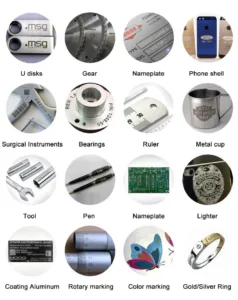
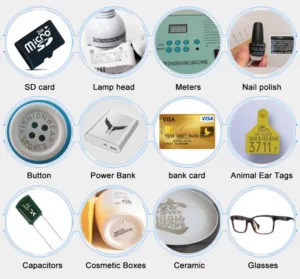
Practicality: Whether it’s a millimeter-square QR code, a hair-thin serial number, or complex logos and patterns, it can all be clearly displayed. It solves the problem of “nowhere to mark” on highly integrated circuit boards (PCB/FPC), glass screens, wafers, medical devices, and other tiny components.
2. The nemesis of “picky” materials
Functionality: Excellent marking effects on metals, plastics, glass, ceramics, silicon wafers, and even various polymer materials. It is particularly adept at handling materials with low infrared laser absorption.
Practicality:
On plastics: It can produce high-contrast white or black marks without producing toxic fumes or scorched edges, meeting environmental protection requirements.
On glass: It can achieve internal engraving or exquisite surface patterns without easily breaking.
On metals: It produces an oxidation discoloration effect, with clear markings that do not affect the material’s conductivity and mechanical properties.
3. Permanent Marking, Protecting Your Brand
Functionality: The marking acts directly on the product surface, offering wear resistance, corrosion resistance, and anti-detachment properties.
Practicality: This is equivalent to giving your product a permanent “identity card.” Whether it’s a QR code for product traceability or a brand logo, it withstands the test of time and the environment, effectively preventing tampering and counterfeiting, protecting the interests of you and your customers.
4. High Efficiency and Energy Saving, Cost Reduction and Efficiency Improvement
Functionality: Fully computer-controlled, automated operation, fast marking speed, and high precision.
Practicality:
Improved Efficiency: One-button start, instant completion, seamless integration with automated production lines, significantly improving production efficiency.
Reduced Costs: No need for consumables such as ink and chemical etchants, achieving “zero-contact” processing. Long-term use can save you significant consumable and labor costs.
Environmentally Friendly and Safe: Pollution-free and consumable-free, meeting the requirements of modern green production.