
When speaking with sales representatives for laser marking machines, we often hear that laser markings are fade-resistant and wear-resistant. This is one of the key differences between laser marking and other marking methods, as well as a core competitive advantage.
The fundamental reason why laser marking is “fade-resistant and highly durable” lies in the fact that it fundamentally alters the properties of the material’s surface, rather than simply “adhering” to it. We can conduct an in-depth analysis from the following perspectives: physics, chemistry, microstructure, and a comparison with traditional processes:
1. Mechanism of Action: From “Additive/Subtractive” to “Modification”
Traditional marking methods (such as printing, inkjet, and screen printing) are additive in nature, meaning they deposit external pigments or inks onto the material’s surface. The strength of this bond is limited by the adhesion between the ink and the substrate; when exposed to friction, solvents, or UV aging, the interface is prone to peeling or fading.
Laser marking, however, involves modification or structural subtraction. A high-energy-density laser beam strikes the material’s surface, where the energy is absorbed by the material and converted into thermal or photochemical energy within an extremely short timeframe (microseconds or even nanoseconds). This process does not rely on external substances but directly alters the structure of the material itself.
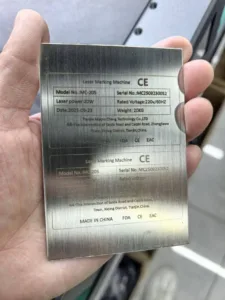
2. Chemical Process: Oxidation Reaction
Chemical Process: For metallic materials (such as stainless steel and anodized aluminum), laser marking is essentially a controlled oxidation reaction. The laser energy rapidly heats the metal surface, causing it to react with oxygen in the air and form an extremely thin layer of metal oxide (such as titanium oxide or iron oxide). The color of this film (black, dark gray, or white) is determined by thin-film interference effects or the inherent color of the oxide itself; it is an integral part of the material’s surface, not a coating applied to it.
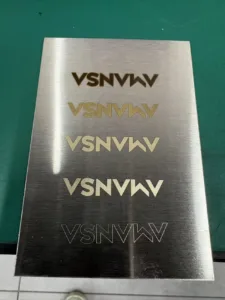
3. Physical Aspect: Microstructural Reconstruction
Interface-Free Structure: The boundary between the laser-marked area and the unmarked area is continuous and seamless. Since the marking is formed through melting, vaporization, or phase transformation, the material in the marked area fuses with the substrate. Traditional ink creates a distinct “interface” with the substrate, and wear often begins at this interface; laser marking, however, lacks this weak point.
Hardness and Density: In metal marking, the laser process is often accompanied by a “laser hardening” effect. The surface grains in the marked area become finer, and a denser martensitic structure may even form, resulting in surface hardness that sometimes exceeds that of the substrate. Consequently, not only does the marked area not wear out first, but its wear resistance is
actually superior to that of the surrounding untreated material.
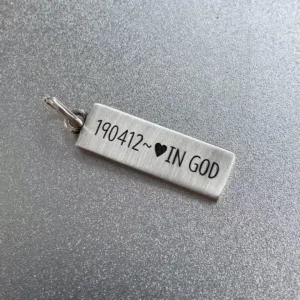
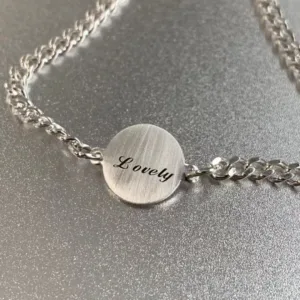
4. Depth and Integration: Micro-embedding
Although laser marking is often referred to as “surface marking,” in reality, different physical depths can be achieved by adjusting laser parameters (such as pulse frequency and power):
Shallow engraving: On metals, the laser can create grooves ranging from a few micrometers to tens of micrometers in depth. These physical indentations are inherently resistant to friction, and the markings will not disappear unless the entire surface layer is removed.
Subsurface: For certain transparent materials (such as glass and acrylic), the laser can be focused within the material to perform “internal engraving.” The mark is located inside the material and is fully encapsulated by the substrate; theoretically, as long as the material remains intact, the mark will never be exposed to external wear and tear.
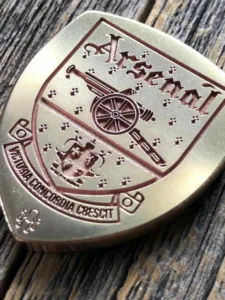
Special Material Case Study: Anodized Aluminum
This is the material that best demonstrates the laser’s “fade-resistant” property. The surface of anodized aluminum features a transparent, hard aluminum oxide layer. During laser marking, the laser energy does not remove this layer or blacken it; instead, it penetrates deep into the oxide layer, “pulling out” oxygen atoms from the aluminum oxide crystals to create oxygen vacancies. These oxygen defects absorb visible light of specific wavelengths, resulting in a black or dark appearance. This black color is caused by defects in the crystal structure and is located within the hard oxide layer, protected by the unmarked oxide layer above it. Therefore, no matter how much friction is applied, as long as the entire oxide layer is not worn through, the marking will remain permanent.
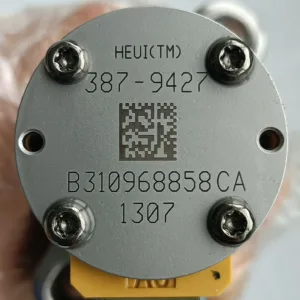
Summary
Laser marking does not fade or wear away because it bypasses the concept of “coating.” It uses high energy to directly alter the material’s chemical properties (by creating oxides or carbides) or physical structure (by forming micro-pits or internal engravings), making the mark an integral part of the material itself. As long as the workpiece itself does not disintegrate due to extreme wear, the mark will remain permanently.